Haemodialysis (HD) cleans your child’s blood by putting it through a dialysis machine. The clean blood is then returned to your child’s body and the dialysis fluid that helps to clean the blood is thrown away.
How often will my child have haemodialysis?
Most children have haemodialysis three times a week, with each session lasting around four hours. It is normally done during the day. Although children are connected to the machine, they can read, do school work, play with toys or sleep while they are having dialysis.
Where will my child have haemodialysis?
Your child can have haemodialysis in hospital or in a separate specialist dialysis unit.
Some children can have haemodialysis at home (home haemodialysis). Your child’s kidney team will give you lots of training and support to do this.
For more information see Home haemodialysis | Kidney Care UK
What needs to happen before my child can start haemodialysis?
During haemodialysis your child’s blood is taken from their body and cleaned in a dialysis machine.
For most children, access to their bloodstream is through a special connection in their arm called an arterio-venous (AV) fistula. This is made by a small surgical procedure which joins two types of blood vessels: an artery (which carries blood from the heart round the body) and a vein (which carries blood back to the heart). This makes one large, stronger blood vessel.
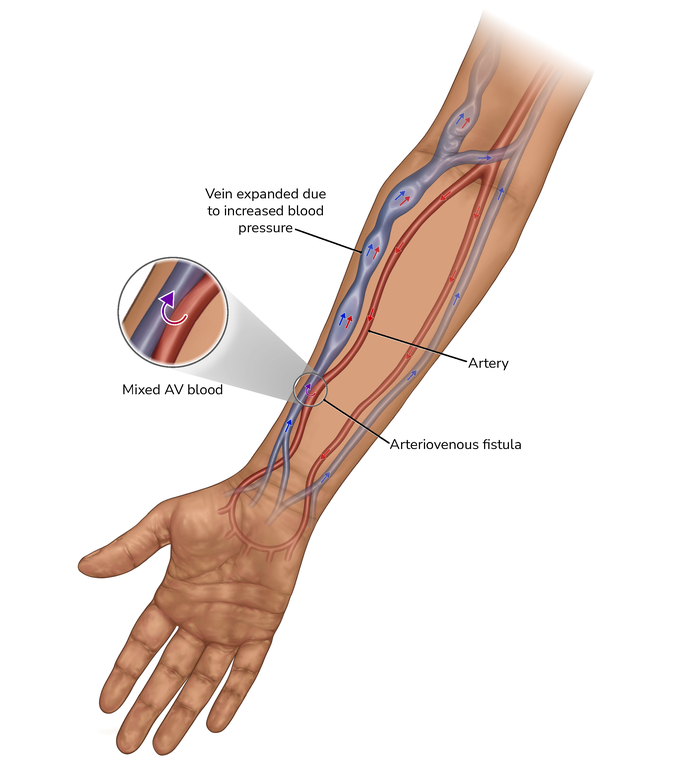
If your child’s blood vessels are very small or fragile, a piece of tubing called an arterio-venous graft may be used instead of a fistula.
A fistula needs to be made about six to eight weeks before your child starts dialysis, to allow time for it to ‘mature’ and get strong enough.
For more information see Haemodialysis access with an arteriovenous fistula | Kidney Care UK
If your child needs dialysis before their fistula or graft is ready or they are unable to have one made, they can have haemodialysis through a special dialysis line in their neck (central venous line). This can be used immediately.
What happens during haemodialysis?
- Your child is connected to the dialysis machine. If they have a fistula, one or two needles are inserted into it – special gel or cream can be used to help your child stop feeling any pain. The needle(s) are placed in the fistula each dialysis session. If your child has a line, the tubes will be connected to the port(s) at the end of the catheter.
- The dialysis machine pumps blood out of your child’s body through the tube. The blood passes into a dialyser which sits outside the machine.
- The dialyser has a membrane that contains millions of small holes that acts as a sieve or filter – this works a bit like the filters in your child’s kidneys (the glomeruli). The dialyser is continuously bathed with a special fluid called dialysate.
- As blood passes through the dialyser, waste products and salts move across the dialyser membrane into the dialysate fluid and are safely removed from the body.
- Excess water also filters out of the blood through the membrane and is removed from the body. This is called ultrafiltration.
- The cleaned blood is then pumped back out of the dialyser through another tube and back into your child’s body. Blood is pumped out of and into the body quickly – only a small amount of blood is outside the body at any time.
- After the dialysis session, your child is disconnected from the machine. The nurse will take your child’s blood pressure and temperature and weigh them to check that the right amount of fluid has been removed.
Will my child need any other medication while on haemodialysis?
Your child will usually have a blood thinner medication when they have haemodialysis. This is to stop their blood from clotting while it is in the dialysis machine. It will wear off afterwards.
If your child develops anaemia (a shortage of red blood cells) they may be prescribed iron supplements and a medicine called erythropoietin (EPO). EPO is a hormone the kidneys normally make to tell the body to produce red blood cells.
Are there any risks or side effects to haemodialysis?
Risks from creating haemodialysis access
- Creating a fistula: risks include bleeding, or the fistula failing to develop, which may mean that a repeat operation or a graft needs to be made instead.
- Inserting a central venous line: risks include bleeding, bruising or the formation of a blood clot around the end of the line.
Other risks
- ‘Steal syndrome’ in a fistula – where there is less blood flow to the hand, which may cause a feeling of tingling, numbness or cold in the hand, and may require surgery.
- Infections due to germs entering the body – this is more likely in a line than in a fistula. Keeping the exit site clean will reduce the risk. Most infections can be treated with antibiotic medicines, which kill germs. If they are more serious, surgery and/or a new line may be needed.
- Blood clots (thrombosis) – if this happens in a line, fistula or graft, it may stop working. It is important to know this as soon as possible in a fistula. You will be shown how to check your child’s fistula at least twice a day.
- Narrowing of blood vessels (stenosis) – this usually happens slowly and your child’s dialysis team can look for early warning signs.
Side effects of haemodialysis
Most side effects are caused by changes in the amount of water and chemicals in your child’s blood. Your child should follow the treatment plan set out by your doctor, including diet, fluids and medicines, to avoid these side effects. Side effects your child may get are:
- feeling tired during or after the dialysis session
- muscle cramps
- low blood pressure (hypotension), which may be sudden – children may feel weak, dizzy or light-headed, or sick.
For more information see Haemodialysis
This web page is printer-friendly.
To save the page as a PDF, print as normal and select "Save as PDF" as your printer destination.
Share this page with a QR code, print or save as PDF
Click on the blue box (on the right or below) and scan the QR code with your phone or tablet.